Showing posts with label taos a to z. Show all posts

Wednesday, March 28, 2012

Taos A to Z Excerpt: Village

Definition: “A group of houses and associated buildings, larger than a hamlet and smaller than a town, situated in a rural area; a self-contained district or community within a town or city, regarded as having features characteristic of village life.”


Villages do exist in Northern New Mexico, due to the popularity of rural living throughout the area. Usually, the role of the village is to offer minimal, yet vital, services to those living in the immediate area, such as a post office, a general store, a gas station, etc. One of the most popular villages in the Taos, New Mexico, area is Arroyo Seco (pictured above), known for its quaint, authentic Northern New Mexico atmosphere. ~Jean

Read more about Taos, Santa Fe, and Northern New Mexico on Taos A to Z

Wednesday, March 7, 2012

Taos A to Z Excerpt: Highfalutin

Definition: “Pompous or pretentious speech, writing, or ideas.” Origin: “mid-19th century, during the period of the populating of the Old West.” ~Jean

Read more about Taos, Santa Fe, and Northern New Mexico on Taos A to Z

Monday, February 27, 2012

Taos A to Z Excerpt: Horno

Horno is Spanish for “oven.” In the Southwest, a horno generally refers to a wood-fired oven made of adobe mud, often in the shape of a beehive. Native Americans still use the outdoor horno to cook a special delicacy called “fry bread.” Recently, dog houses have been made in the igloo shape of a horno, for those Santa Fe and Taos residents who want their pooches to enjoy New Mexico style. ~Aimee


Read more about Taos, Santa Fe, and Northern New Mexico on Taos A to Z

Friday, February 10, 2012

Taos A to Z Excerpt: Ghost Ranch

Located in Abiquiu, New Mexico, Ghost Ranch was the home of artist Georgia O'Keeffe from 1949 until her death in 1986. Located in an area known for its breathtaking red rock formations, it is now a retreat and popular tourist attraction in Northern New Mexico, an easy day trip from either Taos or Santa Fe. ~Aimee


Read more about Taos, Santa Fe, and Northern New Mexico on Taos A to Z

Friday, January 27, 2012

Taos A to Z Excerpt: Tamale


A tamale (in Spanish, “tamal”) is a traditional Mexican dish consisting of steam-cooked corn dough (masa) with or without a filling. The most common filling is pork, but chicken is also used, in either red or green salsa or mole. Tamales can also be filled with cheese, sliced chiles, or other ingredients. The tamale is wrapped in a corn husk before cooking. Tamales are a favorite dish in Mexico that take several hours to prepare and cook. In Northern New Mexican cities and towns, many locals market homemade tamales in shopping areas and supermarket parking lots. For those who love tamales, but don’t have the time or skill to prepare them, this is an easy way for them to enjoy the classic Mexican treat. ~Jean

Read more about Taos, Santa Fe, and Northern New Mexico on Taos A to Z

Wednesday, January 11, 2012

Taos A to Z Excerpt: Adobe

Definition: “A kind of clay used as a building material, typically in the form of sun-dried bricks; a brick of such a type or a building constructed from such material.” Origin: “mid-18th century: from Spanish, adobar meaning ‘to plaster.’”

Adobe has long been the traditional building material of the Southwest. Structures made from it are undulating and sculptural in nature, yet their mass gives them a sense of permanence and timelessness. The word adobe originated in the Arabic language and was brought to America by Spanish colonists at the end of the 15th century. It is used to refer to the earth from which structures are built, the structures themselves, and the unbaked clay bricks made from the earth.


In New Mexico, archaeologists have discovered remnants of adobe walls built by Pueblo Indians that date back to 1200 AD, 400 years before the arrival of the Spanish. From that time, through the 15th century, there is evidence of two types of earthen walls. One was coarse adobe, which started with a stiff mixture of mud and was blended with anything from stones to pot shards. The mud was applied by the handful, layer on top of layer, until the desired wall height had been reached. A more sophisticated method made use of hand-formed, unbaked clay bricks. When the bricks were dry, mud mortar was used to hold the bricks in place on the wall.

Believe me, nothing can take the place of the feeling you get when you enter an old, well-maintained adobe structure. In the summer, it’s akin to walking into a cool, refreshing cave; and in the winter, there is nothing more delightfully cozy than sitting in front of an authentic kiva fireplace. Ultimately, it’s a big part of the process of truly being in touch with the wondrous and sacred land that is America’s Great Southwest. ~Jean

See our special feature about Adobe on Taos Unlimited

Read more about Taos, Santa Fe, and Northern New Mexico on Taos A to Z

Monday, December 26, 2011

Taos A to Z Excerpt: Burro (or Donkey)

A domesticated member of the horse family, the donkey’s wild ancestor is the African Wild Ass. Males are called jacks and females jennies. Offspring have the same names as horses (i.e., foal for either sex under one year, and colt and filly for males and females who are over one year old). Different species within the Equidae, or horse family can interbreed, however, their offspring are almost always sterile. A mule is the offspring of a jack, or male donkey, and a mare, or female horse. Though rarely successful, the offspring of a stallion (male horse) and a jenny (female donkey) is a hinny.


The Spanish brought burros to North America where they quickly became the chosen beast of burden of early prospectors, due to their sure-footedness. While many use the terms donkey and burro interchangeably, others call the smaller Mexican descendants burros, and their larger cousins, imported directly from Europe, donkeys.

Burros which were abandoned or ran away gave rise to feral burros in the Western range lands. Fortunately, these animals are now protected in New Mexico, where they are considered to be a living legacy. During drought conditions, herds are at risk, and are routinely thinned to preserve grazing. Roundups remove a percentage of the feral burros which are then auctioned to the public. Wild burros are clever and curious, making excellent pets when treated well and trained properly. Once trust has been established, they greatly enjoy the company of humans. ~Aimee

Read more about Taos, Santa Fe, and Northern New Mexico on Taos A to Z

Monday, December 12, 2011

Taos A to Z Excerpt: Farolito (or Luminaria)


The first luminarias in North America were bonfires of crisscrossed pinon boughs arranged in 3-foot high squares. The Pueblo Indians in New Mexico have long made these small fires outside their homes to light their way to church on Christmas Eve. Later luminarias were small paper lanterns made from colored paper brought to this continent from the Orient. Instead of hanging these delicate lanterns from trees or on wires, they were placed on the ground, on rooftops and along pathways. Today, the word farolito is used in Northern New Mexico, while luminaria is used in Central and Southern New Mexico. Contemporary farolitos are small brown paper bags, filled with an inch of sand that supports a candle. At Christmas time, New Mexico streets and rooftops are lined with these festive lights. ~Aimee

Read more about Taos, Santa Fe, and Northern New Mexico on Taos A to Z

Friday, November 25, 2011

Taos A to Z Excerpt: Cornbread

Definition: “A type of bread made from cornmeal and typically leavened without yeast.” Native Americans were using ground corn for cooking long before the European explorers arrived in the New World. The Native Americans learned early to dry and grind corn into corn meal, the basic component of cornbread. When mixed with eggs and corn flour, the easiest and simplest of cornbreads can be made. Thin, dense, and flat, it was a healthy food that could be transported long distances for months at a time. Cornbread was first discovered by Europeans during their exploration of North America. Europeans who had to use the local resources for food, fashioned cornmeal into cornbread. Cornbread was popular during the Civil War because it was very cheap and could be made in many different sizes and forms.


Cornbread is a common bread in United States cuisine, particularly associated with the South and the Southwest. It is often eaten with pinto beans or chili. Cornbread crumbs are also used in some poultry stuffings, with cornbread stuffing being closely associated with Thanksgiving Day turkeys. Some prefer a sweetened version of cornbread, while in the South and the Midwest, the sugar is left out and the cornbread is saltier. In Texas (and the Southwest), the Mexican influence has spawned a hearty cornbread made with fresh or creamed corn kernels, jalapeno peppers, and shredded cheese as a topping. Variations of cornbread include: hush puppies, corn pones, and johnnycakes. ~Jean

Read more about Taos, Santa Fe, and Northern New Mexico on Taos A to Z

Friday, November 11, 2011

Taos A to Z Excerpt: Buckskin (or Buckskins)

Clothing made from the soft leather of deer or elk, with the underside (or the suede side) turned to the outside. Usually consisting of a jacket and leggings, buckskins were usually trimmed along the seams with fringe, to wick the water away in the rain. Originally common to certain tribes of American Indians, buckskins became popular among mountain men for their warmth and durability. Some of the famous icons of the Old West who wore buckskins were Wild Bill Hickock, Calamity Jane, Buffalo Bill, and Annie Oakley. ~Aimee
Left: Buffalo Bill in his buckskins

Read more about Taos, Santa Fe, and Northern New Mexico on Taos A to Z

Wednesday, October 26, 2011

Taos A to Z Excerpt: Serape

A long blanket-like shawl, often brightly colored and fringed at the ends, worn especially by Mexican and Southwest Indian men. ~Aimee

Read more about Taos, Santa Fe, and Northern New Mexico on Taos A to Z

Wednesday, October 12, 2011

Taos A to Z Excerpt: Fringe

Definition: “An ornamental border of threads left loose or formed into tassels or twists, used to edge clothing or material.” Fringe originates in the ends of the warp, projecting beyond the woven fabric, but many times it is made separately and sewn on, consisting sometimes of projecting ends, twisted or plaited together, and sometimes of loose threads of wool, silk, and linen; or in the case of Western wear, narrow strips of leather. Commonly found on Western-style leather coats, jackets, pants, boots, and handbags, fringe adds that extra special “cowboy” touch to both vintage and contemporary Southwestern apparel. ~Jean

Read more about Taos, Santa Fe, and Northern New Mexico on Taos A to Z

Monday, September 26, 2011

Taos A to Z Excerpt: Ristra


A method of hanging chiles, garlic and other foodstuffs on a string for drying and storage. They are commonly used for decoration inside and outside adobe houses in Taos and Santa Fe. New Mexican legend has it that hanging a ristra outside your home brings good luck. ~Aimee

Read more about Taos, Santa Fe, and Northern New Mexico on Taos A to Z

Monday, September 12, 2011

Taos A to Z Excerpt: Chamisa


Chamisa (also known as Rabbitbush) is a member of the Asteraceae family. It is a deciduous shrub, similar to sagebrush with a native range in the arid Western United States and Mexico. It is a shrubby, 12- to 90-inch perennial, producing pungent-smelling, golden-yellow flowers in late summer and early fall. Chamisa is seen literally everywhere in Northern New Mexico and is synonymous with the landscape of both Santa Fe and Taos. Chamisa is a significant source of food for browsing wildlife on winter ranges. Dense stands of chamisa often grow on poorly managed rangelands, in disturbed areas along roadways, and on abandoned agricultural property. It is, however, locally prized as a xeriscape plant that needs little care or specific watering. It thrives in a wide range of coarse, alkaline soils that are common to desert environments. Pruning the shrub back to several inches in early spring, before new growth begins, may help improve its ornamental value. I love chamisa! ~Jean

Read more about Taos, Santa Fe, and Northern New Mexico on Taos A to Z

Wednesday, August 24, 2011

Taos A to Z Excerpt: Bandana

Definition: “A large handkerchief or neckerchief, typically of cotton, often having a colorful pattern; a red paisley bandana kerchief, neckerchief, headscarf, or babushka.” A kerchief (from the French, couvre-chef, “cover the head”) is a square or triangular piece of cloth tied around the head or neck for protective or decorative purposes. Bandannas are worn as a practical garment by outdoor workers such as farmers and cowboys, who wear them around the neck to wipe the sweat off their faces and keep dust out of their collars.

There are several methods of bandana folding and many different uses for them. In the past, these handy handkerchiefs were folded into common workers’ squares, and tucked into pockets for the more traditional uses, but they have also been used as bandages, compresses to stop bleeding, and folded into triangles, to be worn around the neck as slings.


Cotton bandanas in regulation sizes, are available in a multitude of patterns and colors. Today, bandanas have many new uses, and are in style as head coverings, and are folded and worn in different ways.

Bandana folding: Regular bandanas, being square, are folded into a triangle, placed low on the forehead, just above the eyebrows, and tied in a manner to secure the back triangle to the head. These are often worn by motorcycle enthusiasts underneath their helmets, or as Western wear, alone or under a cowboy hat. Folded bandanas can also become a type of head scarf, when they are folded into a triangle, placed on the top of the head, brought behind the ears, and tied to leave the back triangle point free. ~Jean

A Bit of Personal Bandana Trivia: About 10 years ago, I took to wearing a bandana on my head almost every time I went outside or into town (the exception would be if I chose to wear a cowboy hat, instead). For quite awhile I was unaware that anyone took notice of it. Then, one day I met with a woman for some business concerns and the first thing she said to me was, “Oh, you’re the woman who always wears the bandana! I see you at the market quite often.” Now, I find more and more, people seem to compliment me on the bandana I am wearing. I have collected quite a few unusual and colorful ones over the years! ~Jean

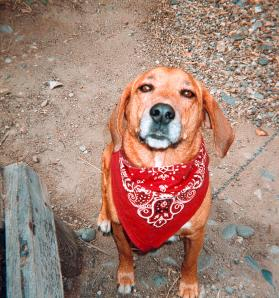
 Above: My dog, Juno, wearing his favorite bandana.

Read more about Taos, Santa Fe, and Northern New Mexico on Taos A to Z

Wednesday, August 10, 2011

Taos A to Z Excerpt: Arroyo

Definition: “A steep-sided gully cut by running water in an arid or semi-arid region.” An arroyo is a nearly vertically walled, flat floored stream channel that forms in fine, cohesive, easily eroded material. Arroyos can cut as deeply as 65 feet into the valley floor, are often wider than 165 feet, and can be hundreds of miles long. Arroyos exist throughout the Western United States, but are most common in arid and semi-arid climates in the Southwest. They are found throughout New Mexico.


The rapid widening and deepening of arroyos have both changed the physical environment and been a costly nuisance in the West since settlement began in the mid-1800s. From 1870 to 1890, the number of livestock in New Mexico alone increased from 300,000 to 2,300,000. Valley floors, which were the most dependable forage areas for the animals, were quickly overgrazed. The fragile vegetation was consumed, and the soil was compacted and left extremely susceptible to erosion. To further exacerbate the soil conditions, both humans and livestock created trails along stream channels and nearby hillsides forming small ditches, leaving the land surface susceptible to arroyo formation. ~Aimee

Read more about Taos, Santa Fe, and Northern New Mexico on Taos A to Z

Monday, July 25, 2011

Taos A to Z Excerpt: Lizard


A large, widespread group of reptiles with nearly 5,000 species, lizards range across all continents except Antarctica. Lizards typically have four limbs, external ears, and a long tail. Many species of lizards can detach their tails for the purpose of escaping from predators. Lizards are very common in the Southwest, often spotted climbing New Mexico’s exterior adobe walls... and as decor, they can be found on interior adobe walls as well. ~Aimee

A Bit of Lizard Rock Trivia: Rock icon, Jim Morrison (lead singer of the 1960s rock group, The Doors), was known as the “Lizard King.” Jim Morrison’s deep connection to shamanism often took form as iconography in his writing. In his lyrics for the epic performance/song Celebration of the Lizard, he would speak, “I am the lizard king. I can do anything.” This is the origin of the “Lizard King” moniker. Although several attempts were made to record “Celebration of the Lizard,” only one small section of it was released as “Not to Touch the Earth” on The Doors’ third album, “Waiting for the Sun.” ~Aimee


Read more about Taos, Santa Fe, and Northern New Mexico on Taos A to Z

Monday, July 11, 2011

Taos A to Z Excerpt: Fry Bread

An extremely popular Native American food, found throughout the United States, fry bread is a flat dough pan- or deep-fried in oil, shortening, or lard. The dough is generally leavened by yeast or baking powder. Topped with additions such as beans, ground beef, or shredded cheese, fry bread is then served as “Indian tacos” or “Navajo tacos.” Fry bread is also served sweet, with powdered sugar on top.

Some say that fry bread came from the time when about 8,000 of the Navajo people were imprisoned at Fort Sumner, New Mexico, during the 19th century. It is said that the Navajos were just given wheat flour and lard to eat, two commodities that were quite foreign to their bean and corn-based diets. Others say that the Navajo and folk of other tribes made the bread because they didn’t know what else to do with the government-granted wheat and fat they were provided on the reservations. Regardless, once you’ve tasted fry bread in any of its forms, you’ll want to come back for more! ~Jean

Read more about Taos, Santa Fe, and Northern New Mexico on Taos A to Z

Friday, June 24, 2011

Taos A to Z Excerpt: Vest

Definition: “a close-fitting waist-length garment, typically having no sleeves or collar and buttoning down the front.” Origin: King Charles II introduced the vest (or waistcoat) in England by Royal Proclamation on October 7, 1666. It was a simple straight cut, close-fitting garment made from black cloth with a white silk lining. Promoted personally by the King, it was soon popular with everyone. However, the political purpose was to undermine French fashion influence in England, and the vest’s simple lines was meant to defy the extravagant dictates of Versailles. The vest was based on a style brought back to England by visitors to the Persian court of Shah Abbas. It became sleeveless around the 1750s, and the garment eventually made its way to the New World.

When young men began traveling out West in the 1860s, they brought the current “highfalutin” Eastern fashions with them, which included tailored trousers, suitcoats and vests. They simply added the Western accents, such as a cowboy hat, bandana scarf, and a gunbelt to the mix. You then had the “gentleman cowboy” look, so well depicted in the films, “Silverado,” “Wyatt Earp,” and “Tombstone.” There were also “western style” vests, made from suede and leather, with elaborate fringing. This was more the “mountain man” or “outlaw” look, also depicted in western movies.

The fringed, Western-style vest reached an extremely high level of popularity in the late 1960s, when it became almost a uniform for a generation of Hippies. Today, it is worn by people of all ages, both male and female. Whether it is used for actual daily wear, or reserved for special occasions (and/or trips to Taos and Santa Fe), it is, without a doubt, a fun fashion that has survived over the centuries. ~Jean

Friday, June 10, 2011

Taos A to Z Excerpt: Getting Hitched

An Old West term, meaning “getting married.” It was derived from the practice of horses being hitched to a wagon. Used as slang even today, it leads one to believe that somehow marriage is a burden or sharp restriction of an individual’s freedom. I’ll leave this for the reader to decide. ~Jean

Read more about Taos, Santa Fe, and Northern New Mexico on Taos A to Z